Physical Address
304 North Cardinal St.
Dorchester Center, MA 02124
Physical Address
304 North Cardinal St.
Dorchester Center, MA 02124
Can a married couple both collect Social Security benefits at the same time? The short answer is yes, and there is no marriage penalty that reduces either spouse’s payment.
Here is a quick summary:
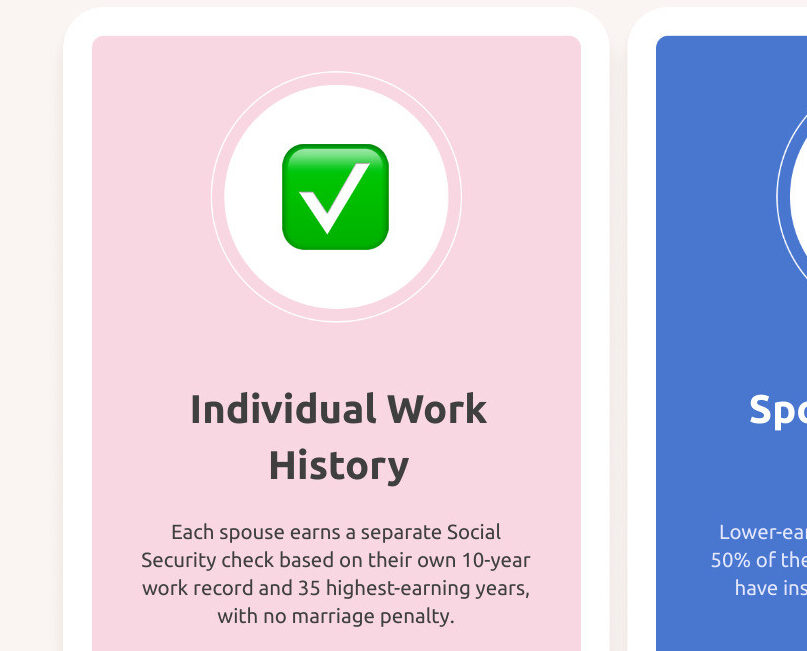
For example, if one spouse receives $1,400 per month and the other receives $1,200, the household collects $2,600 per month combined, with neither check affecting the other.
But knowing that you can both collect is just the starting point. How you claim, and when, can mean tens of thousands of dollars of difference over your lifetime together.

When we talk about retirement planning, one of the most common myths we hear is that married couples are limited to a single check or that one spouse’s earnings will “cancel out” the other’s. This couldn’t be further from the truth.
In the eyes of the Social Security Administration (SSA), you are two distinct individuals with your own work records. If both of you have spent years in the workforce, you are both entitled to your own separate payments. There is absolutely no “marriage penalty” for retirement benefits; in fact, being married often opens up more doors for maximizing your household income. You can learn more about the specifics of this in our guide on Do Both Spouses Collect Social Security.
According to experts at Kiplinger, coordinating these benefits is one of the most powerful tools a couple has to secure their financial future.
To qualify for your own retirement benefits, you generally need to earn 40 “credits.” Since you can earn up to four credits per year, this usually translates to about 10 years of work. The SSA calculates your Primary Insurance Amount (PIA) based on your 35 highest-earning years, adjusted for inflation.
If both spouses meet these requirements, you will each receive a check based on your respective earnings record. One spouse’s high salary does not reduce the benefit of the lower-earning spouse.
Yes, you can both start collecting as early as age 62, but there is a catch: the “early filing” penalty. If you claim at 62, your benefit is permanently reduced by up to 30% compared to what you would have received at your Full Retirement Age (FRA).
For a couple, this means two smaller checks for the rest of your lives. Before making this leap, we highly recommend using a Social Security Spousal Benefit Calculator to see exactly how much you might be leaving on the table by filing early.
What if one spouse stayed home to raise children or had a significantly lower-paying career? This is where the spousal benefit comes in. A spousal benefit allows one partner to receive up to 50% of the other partner’s full retirement benefit.
To qualify for this, you must be at least 62, and your spouse must already be receiving their own retirement benefits. For a deep dive into these requirements, check out What is a Social Security Spousal Benefit and this AARP FAQ on spousal benefits.
You might be wondering, “Can I get my own check and a spousal check?” The SSA uses what we call the “Higher Of” rule. If you are eligible for both your own retirement benefit and a spousal benefit, the SSA will pay your own benefit first. If the spousal amount is higher, they add a supplemental payment to make up the difference. Essentially, you get a total amount equal to the higher of the two, but not both combined.
As the SSA clarifies, they always prioritize your own work record first.
While there is no limit on two spouses collecting their own earned benefits, there is a “Family Maximum Benefit” cap if multiple people (like a spouse and a dependent child) are claiming based on a single worker’s record. This cap typically ranges between 150% and 188% of the worker’s PIA. However, if both spouses are claiming based on their own work records, this limit does not apply to their combined household income.
At Smart Money & Tech Tips for Americans, we love a good strategy. When it comes to Social Security, the most effective strategy is often patience. For every year you delay claiming past your FRA (up until age 70), your benefit increases by about 8%.
By the time you reach 70, your check could be 132% of your base amount! Vanguard suggests that coordinating the timing of these claims is key to maximizing lifetime income.
A popular approach is the “split strategy.” In this scenario, the lower-earning spouse claims their benefit early (perhaps at FRA) to provide immediate household cash flow. Meanwhile, the higher-earning spouse waits until age 70 to claim.
This does two things: it maximizes the largest possible check for the household and ensures that the eventual survivor benefit is as high as possible. You can find more on these tactics in this Nolo guide on maximizing retirement.
Survivor benefits are different from spousal benefits. While a spousal benefit is capped at 50%, a survivor benefit can be up to 100% of the deceased spouse’s check. If the higher earner waits until 70 to claim, they aren’t just boosting their own check they are protecting their spouse. When the first spouse passes away, the survivor can switch to that higher amount, providing vital financial security in later years.
The rules changed significantly with the Bipartisan Budget Act of 2015. Many “loopholes” that allowed couples to “file and suspend” or claim only a spousal benefit while letting their own grow are now gone for most people.
Today, “deemed filing” is the standard. This means that when you apply for your retirement benefit, you are “deemed” to be applying for spousal benefits at the same time. You can’t choose one and save the other for later; the SSA will simply give you the highest amount you qualify for at that age. This rule applies to everyone who turned 62 after January 2, 2016. AARP explains that this was designed to prevent people from “double-dipping” in ways the system didn’t intend.
You can still “voluntarily suspend” your benefits after reaching FRA to earn delayed retirement credits. However, be careful: if you suspend your benefits, any spousal benefits being paid out on your record (to your husband or wife) will also be suspended. You can’t stop your own check to let it grow while your spouse continues to collect a “half-check” based on your work.
Social Security isn’t just for currently married couples. If you were married for at least 10 years and have been divorced for at least two, you may be eligible to claim benefits based on your ex-spouse’s record—even if they haven’t retired yet! This does not affect your ex-spouse’s benefit or the benefit of their current spouse.
For more insights on how these rules specifically affect women, who often have different career trajectories, see the SSA’s publication on 5 things every woman should know.
Divorced spouses are “independently entitled.” This means you don’t even have to talk to your ex to claim; you just need to prove the marriage lasted 10 years. This is a vital safety net for those who may have spent years out of the workforce during a long marriage.
It is important to distinguish between Social Security Retirement and Supplemental Security Income (SSI). While retirement benefits have no marriage penalty, SSI (a means-tested program for those with very low income) actually does have one.
Married couples on SSI receive a Federal Benefit Rate (FBR) that is only 1.5 times the individual rate, rather than double. This leads to much higher poverty rates for married SSI recipients (45.1%) compared to non-married recipients (9.8%).
As of May 2026, the maximum possible monthly payment for an individual reaching full retirement age is $4,152. If that same individual waits until age 70, the maximum jumps to $5,181. To hit these numbers, you must have earned the maximum taxable income for at least 35 years of your career.
No. Whether your spouse collects a retirement benefit based on their own record or a spousal benefit based on yours, your personal check remains the same. The funds for spousal benefits come from the general Social Security trust fund, not your individual “account.”
Because of “deemed filing,” you are generally put on the highest benefit immediately. However, if your spouse hasn’t retired yet, you might start on your own record and then “top off” with a spousal benefit once they finally file. The SSA will automatically adjust your payment to the higher amount.
Navigating Social Security as a couple doesn’t have to be a headache. At Smart Money & Tech Tips for Americans, we believe that a little bit of knowledge goes a long way in securing your “golden years.” By understanding that can a married couple both collect social security is a resounding “yes,” and by coordinating your filing ages, you can ensure you’re getting every penny you’ve earned.
Ready to take the next step? Start maximizing your household benefits today by sitting down with your spouse and mapping out your claiming strategy together. Your future selves will thank you!